MoreGPU
Turn the GPUs — or CPUs — you already own into one pooled, sealed, verified, adaptively-throttled compute pool. One-liner install, any OS.

submit → shard → seal → compute on each worker's GPU/CPU → pool → verify
What it is
Run it — three steps
1. Start the admin server. Its first run prints a wizard with this pool's tokens and the exact worker command.
Add --worker (plus --allow-run --allow-sys) and your own machine joins as admin-slot, so you can submit jobs immediately with no separate worker — just like a local GPU.
deno run --allow-net --allow-env --allow-read --allow-write \
  https://raw.githubusercontent.com/ArioMoniri/moregpu/main/apps/coordinator/server.ts
2. Join any machine as a worker with the join token (installs Deno if needed; GPU if present, else CPU).
# Linux / macOS
curl -fsSL https://raw.githubusercontent.com/ArioMoniri/moregpu/main/scripts/install.sh \
  | MOREGPU_SERVER=wss://ADMIN:8787/ws MOREGPU_TOKEN=<join-token> sh
# Windows (PowerShell)
$env:MOREGPU_SERVER="wss://ADMIN:8787/ws"; $env:MOREGPU_TOKEN="<join-token>"
irm https://raw.githubusercontent.com/ArioMoniri/moregpu/main/scripts/install.ps1 | iexAdd MOREGPU_SERVICE=1 to install a reboot-surviving, self-healing service.
3. Submit a job (admin token) — benchmark mode, or send your own tensors (data mode) and get results back.
curl -X POST http://ADMIN:8787/submit -H "authorization: Bearer <admin-token>" \
  -H "content-type: application/json" -d '{"kernel":"matmul","size":1024}'
What is a token?
.moregpu-server.json — no one shares another pool's credentials. Two are yours to hand out; one never leaves the server.
/workers, /jobs, /metrics. Send only over TLS, in the Authorization header.wss://..moregpu-server.json.MoreGPU is single-trust-domain: enrolled workers hold the tenant key, so sealing protects data on the wire, not from the workers. Full model + hardening/TEE roadmap in SECURITY.md.
Adaptive per-user throttle
Isolated, sealed, signed
wss://).Compute kernels
Enough to compose a real attention block and small MLPs (all fp32, verified). Extensible — add a WGSL kernel plus a CPU reference to support a new op. See AI usage.
Can it run what I run?
An honest, verified fp32 linear-algebra service — ✅ native · 🧩 compose from primitives · 🟡 partial · ❌ not supported.
| Workload | How / why | |
|---|---|---|
| Dense fp32 matmul / GEMM | ✅ | Workgroup-tiled WGSL GEMM on the GPU (shared-memory tiling), verified. fp32 only, no tensor cores → correct but slower than cuBLAS. |
| Elementwise + activations | ✅ | add / mul / scale / saxpy / relu / gelu — WGSL kernels that run on the GPU on a GPU worker (CPU otherwise). Memory-bound, so the GPU mainly relieves the CPU. |
| Softmax / LayerNorm | ✅ | Row-wise WGSL reductions on the GPU on a GPU worker (CPU otherwise), match a CPU reference to ~1e-8. |
| Scaled dot-product attention (1 head) | 🧩 | matmul(Q,Kᵀ)→scale→softmax→matmul(·,V) — verified. Not flash-attention, but the GPT-2 demo adds a client-side KV cache. |
| Transformer block / small MLP inference | 🧩 | Compose LN → matmuls → attention → FFN from the SDK; split a model across workers with weight residency. |
| Small LLM (real GPT-2 124M) | 🟡→✅ | A real GPT-2 runs on the pool (examples/llm_infer.py) matching Hugging Face token-for-token, now with a client-side KV cache. On the native torch worker the resident-model path serves at up to ~66 tok/s warm on an unloaded machine (~6–23 tok/s under load), exact match (examples/llm_serve.py). |
| Fast small-LLM serving (low latency) | 🟡 | The new native torch worker (apps/worker/worker_torch.py, Apple MPS / CUDA) holds a model resident on-device and runs the whole forward per call — one round-trip per token, exact match. Opt-in native tier, not the zero-install WGSL worker. |
| Training / fine-tuning (LoRA) | 🟡 | LoRA fine-tuning on the torch worker — single-worker (examples/lora_finetune.py) and distributed across N workers via DiLoCo (examples/lora_distributed.py): each worker trains its own shard, the coordinator averages adapters + an outer Nesterov step. Verified out-of-band: single-worker bit-for-bit vs a seeded reference, DiLoCo to fp tolerance (~2e-5); run live across a heterogeneous Colab T4 (CUDA) + Mac (MPS) fleet (loss 4.45→1.64/3 rounds). Synchronous DiLoCo; async + secure aggregation are next. |
| Modern architectures (RMSNorm/RoPE/SwiGLU/GQA) | 🟡 | Qwen3-0.6B runs on the pool matching Hugging Face token-for-token (examples/generic_infer.py). Forward-only, ~minutes/token — a portability proof, not a speed win. |
| Large / out-of-core matmul | 🟡 | Sharded across workers + pooled — bounded by WGSL cores + WAN, not NVLink. |
| Big-model inference across machines (pipeline sharding) | 🟡 | Pipeline-parallel sharding (examples/llm_shard.py): split a model's transformer layers into contiguous stages, one per torch worker, piping only activations (never weights) — the low-bandwidth path. Works for GPT-2 and Llama-family (RMSNorm/RoPE) — exact match for GPT-2 (6+6) and SmolLM-135M (15+15) split across 2 workers; each worker holds only its stage. No int8/tensor cores. |
| Custom CUDA/PTX kernels · tensor-core/int8 GEMM · Stable Diffusion · NVENC | ❌ | The portable WGSL path is compute-only fp32/fp16. The opt-in torch worker does run on CUDA via PyTorch on NVIDIA — verified live (GPT-2 served on a Colab T4 through the pool, ~44 tok/s, exact match). cuBLAS uses tensor cores automatically for large fp16 GEMMs, but small-model decode is memory-bound (measured fp16≈fp32 on a T4). No custom CUDA/PTX kernels, no int8 GEMM, no graphics/codec paths. |
It runs the small, correct primitive set it ships on your real GPU with verified results, and lets you compose them into attention, transformer blocks, and small classifiers. An opt-in native torch worker adds device-resident model serving (fast GPT-2, exact match) and LoRA fine-tuning — single-worker and distributed (DiLoCo). It is still not a drop-in for big-model (7B+) inference, tensor-core speed, CUDA kernels, or graphics.
Admin dashboard
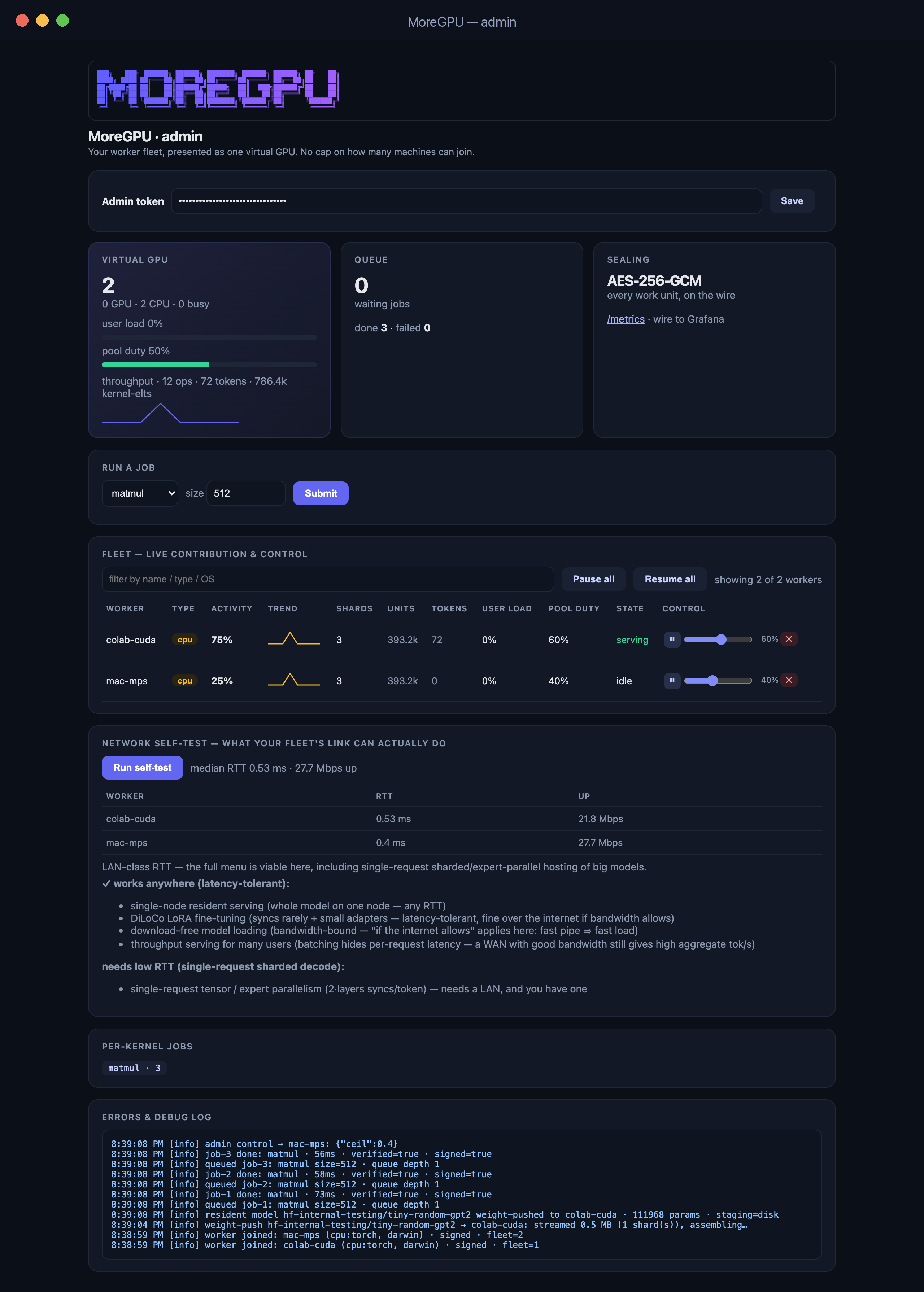
admin-slot row is the built-in worker.Observability (Prometheus + Grafana)
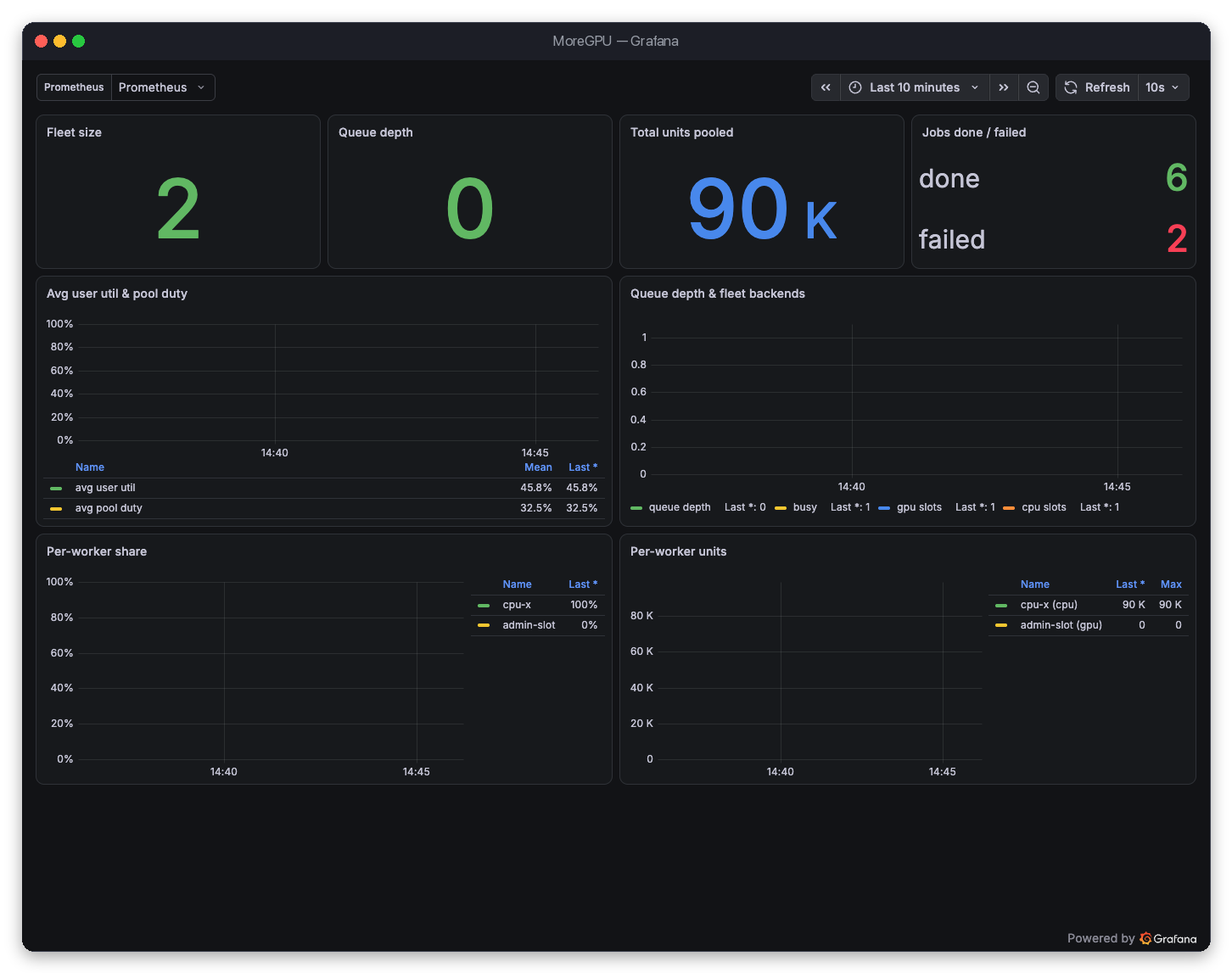
/metrics endpoint exposes fleet size, queue depth, throughput and per-worker contribution. A turnkey Prometheus + Grafana bundle with a pre-provisioned dashboard ships in config/observability — docker compose up, then Grafana on :3000.